





Six new members welcomed into USBC Hall of Fame
April 29, 2026
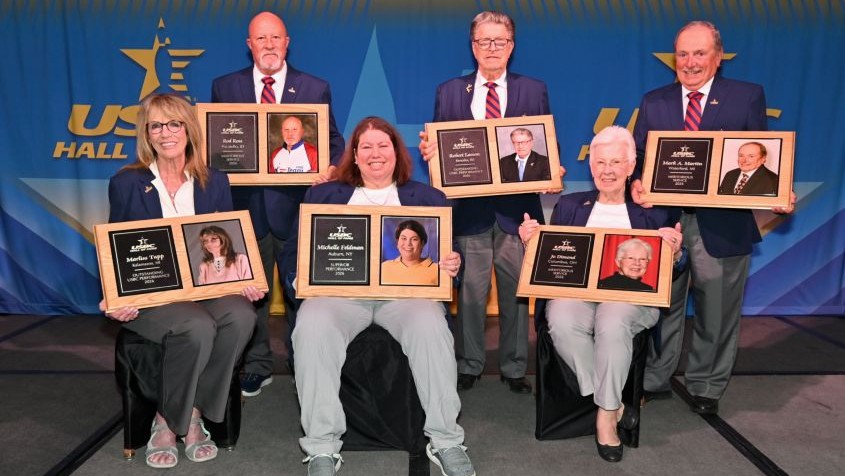
RENO, Nev. – The six members of the 2026 United States Bowling Congress Hall of Fame class were celebrated during their induction ceremony Wednesday evening as part of the USBC Annual Convention.
Michelle Feldman of Auburn, New York, was inducted in the Superior Performance category; Marliss Tapp of Portage, Michigan, and Bob Larson of Kenosha, Wisconsin, were inducted in the Outstanding USBC Performance category; and Jo Dimond of Columbus, Ohio, Mark Martin of Waterford, Michigan, and Rod Ross of Pocatello, Idaho, were inducted in the Meritorious Service category.
All six inductees were in attendance for the ceremony on Wednesday night.
Feldman, 50, amassed 12 professional women’s titles in the span of just nine years (1995-2003) on the Ladies Professional Bowlers Tour (now the Professional Women’s Bowling Association) before the LPBT was forced to shut down after the 2003 season.
She continued to compete in the USBC Women’s Championships and the Professional Bowlers Association’s Women’s Series before injuries prevented her from continuing to bowl competitively.
From an early age, Feldman had a bit of an advantage when it came to her access to the sport.
“I was fortunate because my grandfather used to own a bowling center in Skaneateles (New York),” Feldman said. “It was easy for me to walk into the bowling center and say, ‘Hey grandpa, turn on Lane 5; I want to bowl.’ And then I’d bowl 30 games. Most people don’t have that. I used to joke with my grandpa, ‘Why couldn’t you have owned tennis courts? I’d be skinny, tan and rich!’”
Feldman, a right-hander, earned her first title at the 1996 Columbia 300 Delaware Open and also won titles in 1997 and 1998. She collected multiple titles in 2000 (3), 2001 (2) and 2002 (3) when she also garnered Player of the Year honors. Her 12th and final title came in 2003 at the Dallas Open.
During her win in the 1997 Southern Virginia Open, Feldman, then 21, became the first woman to roll a televised 300 game in women’s professional competition.
Despite being the first woman to accomplish this feat, it might have been tough for anyone to realize how much it meant to her. Shortly after rolling the televised 300, her roommate asked her why she wasn’t more excited about it.
“I had to tell her, ‘I am excited, I just don’t know how to show it!’” Feldman said. “I mean, there was a line of people around the building for my autograph. It was amazing. It was something I’ll never forget.”
In addition to her 12 women’s tour titles, Feldman earned two titles on the PBA Women’s Series (2008) and won the Women’s Series Showdown (2010).
Her record in Women’s Championships competition was sterling as well. Feldman collected five wins at the Women’s Championships, beginning with a Classic Team title in 1998. She won two championships in 2003 (Classic Singles and Classic All-Events) and added another Classic Singles title in 2009 when she shot a then-record 816 series. Her final Women’s Championships victory came in 2011 in Scratch Doubles with Aleta Sill.
Not only was Sill her doubles partner for that 2011 victory, but she also was a friend and mentor during Feldman’s time on the PWBA Tour.
“Aleta took me under her wing I guess you could say,” Feldman said. “She taught me about how to get balls drilled, what surfaces to use, stuff like that. She taught me all those things during my younger days on tour.”
Feldman’s combination of power, competitive spirit and a knack for rising to the occasion during big moments helped propel her to a hall of fame career, and the importance of her USBC induction wasn’t lost on her.
“To me, this is the big one; it’s the biggest one you can go in,” Feldman said. “PWBA is a big one, but USBC is THE big one. It’s the big daddy. This is what anyone who bowls would want to happen one day. I’m thankful that it happened for me. I’m just very, very happy.”
Tapp, 74, was part of four Women’s Championships winning teams in the span of just eight years (1997-2004).
Tapp has always had a penchant for sports thanks in part to her height and athleticism.
“I played a lot of sports most of my life,” Tapp said. “I played a lot of softball and volleyball and played (volleyball) for Western Michigan back in the day. Sports seemed to be my forte. Without sports and my height, I’m not sure what I would’ve done. Thank God I was coordinated.”
Tapp applied that penchant for sports to bowling, and a hall of fame career ensued.
All of Tapp’s championships came in the Classic Team division with the first of the four coming at the 1997 event in Reno, Nevada, as part of the Contour Power Grips team.
The next three championships would come as part of the vaunted High Roller team that collected titles in 2000 (Reno, Nevada), 2002 (Milwaukee) and 2004 (Wichita, Kansas).
Each of the four winning team totals was more than 3,000 with a high of 3,327 at the 2002 event and a low of 3,017 in 1997. The winning team total in 2000 was 3,234, and it was 3,320 in 2004.
Tapp, a right-hander, was part of a pair of record-setting teams as the 3,234 total in 2000 marked the first time the 3,200 mark was reached in the Classic Team division. That total stood as the record for just two years until Tapp’s 2002 team became the first to break the 3,300 barrier with a then-record 3,327 total.
Tapp’s 2004 team came up just shy of the record, finishing just seven pins short with 3,320. The record was broken in 2006 when the Together Once Again team from North Richland Hills, Texas, rolled 3,350.
She was grateful to be able to share her Women’s Championships success with teammates who became lifelong friends.
“What a great bunch of people it was that I got to bowl with on those teams,” Tapp said. “I was so lucky to get to bowl with people I was so close with. It just made everything so much brighter and enjoyable.”
In addition to her teammates, Tapp gave credit to her husband, PBA Tour champion Charlie Tapp.
“Charlie’s been my best coach, my best ball-fitter. He just knows his stuff,” said Tapp.
She also took the time to recognize a couple of her biggest supporters.
“My father, if he was here for this hall of fame induction, he would’ve been so puffy-chested proud,” Tapp said. “And my mother, too. My mother was always ‘rah rah, Marliss.’”
Tapp would compete in 30 Women’s Championships in her career and adds this hall of fame honor to her previous inductions into the Michigan State USBC and the Greater Kalamazoo Bowling Association Halls of Fame.
“I don’t even have words to tell you what this all means to me,” Tapp said. “To put me here with all these great bowlers, I guess I never thought of myself like that. It’s unbelievable.”
Larson, 86, competed in 42 consecutive USBC Open Championships from 1969-2010 and collected four Eagles along the way.
His success in bowling has come despite an almost accidental beginning in the sport.
“Two of my co-workers at Chrysler – American Motors at that time – came up to me and said, ‘Hey, we need another bowler for our team; we’re building a team for our Local 72 Union league that’s going to start pretty soon,’” Larson recalled. “I told them that I’d never bowled before, and they said there was another bowler on the team who had never bowled before either, so I said I’d do it. That was the beginning.”
Larson, a right-hander, was part of three Team All-Events champions and also collected a Regular Doubles title.
Two of Larson’s Team All-Events titles came in back-to-back years as part of the Kendor Corp. No. 1 team out of Milwaukee in 1982 and 1983. The 1982 event was held in Baltimore, and the team successfully defended its title the following year in Niagara Falls, New York.
Larson earned his last two Eagles at the 1986 event in Las Vegas. One of those championships came in the form of yet another Team All-Events title as part of the Faball Enterprises No. 1 team from Milwaukee. His other Eagle was a Regular Doubles title with partner Don Cook.
“The 80s was our time with those teams,” Larson said. “Bowling Magazine had a big article about us, called us the Team of the 80s. We were good friends, two young kids and three veterans. We jelled, and we got along. It was always a good time, and we all had the confidence you needed.”
Larson has three other top-five finishes at the Open Championships as he was part of the fifth-place team in Regular Team (1982) and also had a pair of third-place finishes in Regular Team (1985) and Regular Doubles (1996). He finished with a career average just shy of 200 (198.6) at the Open Championships.
Larson adds this honor to previous inductions into both the Kenosha USBC (1976) and Wisconsin State USBC (2003) Halls of Fame.
His induction into the USBC Hall of Fame had him thinking back to his inauspicious beginning in the sport.
Larson said, “You think about it and you just say ‘Wow!’ I mean, from where I started to here, it’s pretty awesome.”
Dimond’s work and efforts to serve and promote the sport of bowling at all levels, including the national level, have left a lasting impression on those in the bowling industry and inspired others to work for the good of the sport.
Dimond, 78, served three terms on the USBC Board, starting with the 2011-2012 season. Prior to that, she served as a director for the Women’s International Bowling Congress from 2002-2005.
While Dimond has an impressive record of service at the national level, her time at the local and state levels served as the foundation of her time spent in bowling. It was at those levels that she learned some valuable lessons.
“When I first started as the official secretary of my local association, I visited every league, all the women’s leagues and all the mixed leagues, at least once a year,” Dimond said. “I talked to the league officers and the league bowlers. I asked them, ‘What would you like to see?’ I’d like to think that I just listened more and listened well, and I still do a lot of listening.”
Shortly after the merger of the WIBC and American Bowling Congress to create the USBC, Dimond served on the USBC Restructuring Task Force (2008-2009). Her national service includes time spent on the Nominating Committees for WIBC and USBC and as an original member of the Membership Development and Local Delivery System teams for Bowling Headquarters in the early 1990s.
She has served on the Legal and Legislative, National Policy Manual and USBC Hall of Fame Committees and as chair of the Awards and Recognition committee. Additionally, Dimond served on the Performance Standards Task Force and the Membership Task Force. Simply put, there seemingly isn’t an area of national service that Dimond hasn’t touched.
Dimond’s time on the board and committees weren’t without their challenging moments, but she always relished the opportunity.
“Everything wasn’t always perfect, but I wanted to be in a position to ask questions,” said Dimond. “I probably asked too many questions at the board meetings. Some people were OK with that, and some weren’t. I didn’t care. I just wanted things to be better.”
Dimond has also championed charitable causes and worked on fundraising campaigns for national organizations such as Special Olympics (where she learned sign language to better communicate with the bowlers) and the Bowlers to Veterans Link.
Her service to the sport continues as she currently serves as the Association Manager for the Central Ohio USBC, a position she has held since 2005. She also is the conference coordinator for 63 high schools in central Ohio and is the Ohio High School Athletic Association Central District tournament manager.
Her numerous bowling accolades include the 1997 WIBC Helen Baker Award, the 1996 Ohio Association Manager’s Club Gene Myers Award and the 1995 Buckeye Bowling Writers Mary Jannetto Award.
Dimond adds this induction to her previous honors in the Ohio State and Central Ohio USBC Halls of Fame and the Bowling Centers Association of Ohio Hall of Fame.
Typical of Dimond’s nature, she took a humble approach when discussing her induction.
“To me, I’ve just been doing my job,” Dimond said. “Yeah, I did extra stuff, but, to me, you just did that. So, I never thought about it being anything special. It was just something I did. I was just doing my job, and it’s not really been a job to me; it’s just what I wanted to do.”
Martin’s national service in the sport of bowling dates all the way back to the days of the American Bowling Congress and continued through the decades as he participated in a multitude of committees and task forces, chairing many of them.
Martin, 71, started as an ABC Jurisdictional Associate (1998-2002) and then served as an ABC Director (2002-2005). During the conversion of the ABC to the USBC, Martin served on the all-important ABC (2004-2005)/USBC (2006-2007) Strategic Planning Committee.
In the time frame from 2010-2019, he would serve on, and chair, the following USBC committees: Legal and Legislative, National Policy and USBC Hall of Fame. During that same time frame, Martin also served on the Equipment Specifications and Finance Committees. His expertise in all areas of bowling helped bring an experienced and leading voice to each of these areas and committees.
His national service is rooted in a commitment to the sport on the local and state level, and he started at a young age.
“When I was 14, my mother was the coach of our youth program, and I became the secretary of my junior league,” Martin said. “So, I did all the statistics, typed up the master standings, went in and ran the sheets off before league on Saturday morning, those kinds of things. That’s really what started me on my journey to where I am today.”
Martin was a director for the Greater Detroit Bowling Association for 10 years (1986-1996) before serving as Executive Director/Association Manager (1996-2022). He was Zone Director for the Michigan State USBC from 1998-2018 and has chaired the Detroit Hall of Fame Board since 2018.
In the state of Michigan, Martin might be best known in bowling circles as creator and operator of the Michigan State Masters and Senior Masters tournaments (2007-2018). He also served as chairman of the Masters Committee since its inception in 2007 through 2018 and as chairman of the Michigan State USBC Hall of Fame Committee (2010-2018).
Martin, owner of a trio of 300 games, is an accomplished scratch bowler himself, but he always knew his future in the sport wasn’t necessarily going to be as a competitor.
“Whatever I did in life, I wanted to improve,” Martin said. “I knew I wasn’t going to be the best bowler in the world. I knew I wasn’t going to be Walter Ray Williams Jr., but within my competition, I wanted to be good. Same thing with volunteering, I wanted to be one of the best.”
Martin also served bowling through the media. He was host and/or executive producer of a couple of local television shows that featured and promoted bowling – the Michigan Kingpins/Bowling Showcase (2013-2024) and the Greater Detroit Bowling Bonanza (2002-2004). He’s been an award-winning bowling writer for the Oakland Press (1999-2013), a columnist for the Bowlers Digest (1996-2016) and editor of a monthly bowling newspaper – the Bowling Showcase News (2016-2020).
He’s certainly appreciative of everyone he’s met and worked with on his bowling journey.
“I love bowling. I love the people in bowling,” Martin said. “I would never have gotten here today without the help of every person I ever interacted with, every volunteer who ever served in the association . . . all those people helped, and I appreciate all of that.”
In addition to this honor, Martin received the Director of the Year Award from the Michigan State Men’s Bowling Association in 2003, was inducted into the Detroit Bowling Hall of Fame in 2003 and the Michigan State USBC Hall of Fame in 2016.
Ross, 70, has coached numerous professional and world-renowned amateur bowlers and has helped revolutionize coaching in the sport by developing cutting-edge computer and video training technology that have become industry standards, but it’s his work on the national level with Team USA and Junior Team USA that helps set him apart from most coaches.
Ross’ coaching with the national teams started as an assistant coach with Junior Team USA (2002-2004) and then as Junior Team USA’s Head Coach (2004-2017). He was an assistant coach for Team USA (2007-2010) before assuming the mantle as Team USA Head Coach from 2010-2020.
But his foray into coaching started in a manner that is probably a bit different from other coaches.
“I started studying releases, and that’s really how I got into coaching, by studying cause and effect,” Ross explained. “How does a ball fit inhibit or enhance a release, things like that, and it just started building from there. I started loving coaching and learning about the sport.”
Under Ross’ leadership as coach of Junior Team USA and Team USA, the teams amassed more than 300 medals (with more than 150 gold) in the following tournaments: Men’s and Women’s World Championships, World Bowling Youth Championships, World Bowling Junior Championships, Pan American Games, PANAM Elite Championships, World Cup, World Games and PANAM Champion of Champions.
Included in the hundreds of medals in international competition during Ross’ tenure were more than 25 world championships at the adult level, seven gold medals at the Pan American Games and three QubicaAMF Bowling World Cup titles.
From 2010-2012, the Junior Team USA girls, Junior Team USA boys, Team USA women and Team USA men all were the reigning world champions under Ross’ guidance.
Despite all the medals and accolades, it wasn’t always smooth sailing during his time as coach of Team USA.
“We started a program called ETA – Elite Training Assessments – and boy the players gave us a lot of kick back on that right off the bat because we were measuring them,” said Ross. “But after a few years, they started seeing the benefit because it’s just like going to the doctor; it was like a yearly physical check-up for their game. And they could also see that all their work was paying off, and not just because they were winning events, but because they were getting better; they were getting more versatile.”
Prior to his tenure with Team USA, Ross put in the work to become a USBC Bronze-level coach (1991), then Silver (1993) and finally Gold (2000). He also was the coach at the International Training and Research Center during his time as Team USA Head Coach (2010-2020).
Ross has served on the International Bowling Pro Shop and Instructors Association Board of Directors and has been a presenter at the World Bowling Coaching Conference, iCoach in Finland and at USBC coaching conferences. He’s been a member of the International Bowling Federation-Global Coach Education Working Group and served as chair of the World Bowling Coaching Committee.
He received the Friends of IBPSIA Award in 2017 and received the 2005 United States Olympic Committee’s "Doc" Counsilman Science Award for his work in bowling. The award recognizes a coach who utilizes scientific techniques and equipment as an integral part of their coaching methods or has created innovative ways to use sport science.
“You know, I was a pro shop operator that figured out a way to coach,” Ross said. “I figured out a way to use tools and toys to make the job easier because now they (the bowlers) could see it versus saying ‘Well, I think you need to do this.’ Instead, we could show them, prove to them, what they needed to do. The bottom line is that no one is bigger than the program. The program is bigger than anybody and all of us, and it will always continue on.”
Ross adds this hall of fame honor to his previous selections as USOC National Coach of the Year for Bowling (2004, 2010, 2012, 2015, 2019).
With the induction of the 2026 class, there are 470 members of the USBC Hall of Fame – 236 in Superior Performance, 132 in Meritorious Service, 55 in Veterans, 25 in Outstanding USBC Performance and 22 in Pioneer. The Veterans and Pioneer categories are no longer active categories.
The USBC Hall of Fame was created in 2005 by merging the former American Bowling Congress and Women’s International Bowling Congress Halls of Fame.
Michelle Feldman of Auburn, New York, was inducted in the Superior Performance category; Marliss Tapp of Portage, Michigan, and Bob Larson of Kenosha, Wisconsin, were inducted in the Outstanding USBC Performance category; and Jo Dimond of Columbus, Ohio, Mark Martin of Waterford, Michigan, and Rod Ross of Pocatello, Idaho, were inducted in the Meritorious Service category.
All six inductees were in attendance for the ceremony on Wednesday night.
Feldman, 50, amassed 12 professional women’s titles in the span of just nine years (1995-2003) on the Ladies Professional Bowlers Tour (now the Professional Women’s Bowling Association) before the LPBT was forced to shut down after the 2003 season.
She continued to compete in the USBC Women’s Championships and the Professional Bowlers Association’s Women’s Series before injuries prevented her from continuing to bowl competitively.
From an early age, Feldman had a bit of an advantage when it came to her access to the sport.
“I was fortunate because my grandfather used to own a bowling center in Skaneateles (New York),” Feldman said. “It was easy for me to walk into the bowling center and say, ‘Hey grandpa, turn on Lane 5; I want to bowl.’ And then I’d bowl 30 games. Most people don’t have that. I used to joke with my grandpa, ‘Why couldn’t you have owned tennis courts? I’d be skinny, tan and rich!’”
Feldman, a right-hander, earned her first title at the 1996 Columbia 300 Delaware Open and also won titles in 1997 and 1998. She collected multiple titles in 2000 (3), 2001 (2) and 2002 (3) when she also garnered Player of the Year honors. Her 12th and final title came in 2003 at the Dallas Open.
During her win in the 1997 Southern Virginia Open, Feldman, then 21, became the first woman to roll a televised 300 game in women’s professional competition.
Despite being the first woman to accomplish this feat, it might have been tough for anyone to realize how much it meant to her. Shortly after rolling the televised 300, her roommate asked her why she wasn’t more excited about it.
“I had to tell her, ‘I am excited, I just don’t know how to show it!’” Feldman said. “I mean, there was a line of people around the building for my autograph. It was amazing. It was something I’ll never forget.”
In addition to her 12 women’s tour titles, Feldman earned two titles on the PBA Women’s Series (2008) and won the Women’s Series Showdown (2010).
Her record in Women’s Championships competition was sterling as well. Feldman collected five wins at the Women’s Championships, beginning with a Classic Team title in 1998. She won two championships in 2003 (Classic Singles and Classic All-Events) and added another Classic Singles title in 2009 when she shot a then-record 816 series. Her final Women’s Championships victory came in 2011 in Scratch Doubles with Aleta Sill.
Not only was Sill her doubles partner for that 2011 victory, but she also was a friend and mentor during Feldman’s time on the PWBA Tour.
“Aleta took me under her wing I guess you could say,” Feldman said. “She taught me about how to get balls drilled, what surfaces to use, stuff like that. She taught me all those things during my younger days on tour.”
Feldman’s combination of power, competitive spirit and a knack for rising to the occasion during big moments helped propel her to a hall of fame career, and the importance of her USBC induction wasn’t lost on her.
“To me, this is the big one; it’s the biggest one you can go in,” Feldman said. “PWBA is a big one, but USBC is THE big one. It’s the big daddy. This is what anyone who bowls would want to happen one day. I’m thankful that it happened for me. I’m just very, very happy.”
Tapp, 74, was part of four Women’s Championships winning teams in the span of just eight years (1997-2004).
Tapp has always had a penchant for sports thanks in part to her height and athleticism.
“I played a lot of sports most of my life,” Tapp said. “I played a lot of softball and volleyball and played (volleyball) for Western Michigan back in the day. Sports seemed to be my forte. Without sports and my height, I’m not sure what I would’ve done. Thank God I was coordinated.”
Tapp applied that penchant for sports to bowling, and a hall of fame career ensued.
All of Tapp’s championships came in the Classic Team division with the first of the four coming at the 1997 event in Reno, Nevada, as part of the Contour Power Grips team.
The next three championships would come as part of the vaunted High Roller team that collected titles in 2000 (Reno, Nevada), 2002 (Milwaukee) and 2004 (Wichita, Kansas).
Each of the four winning team totals was more than 3,000 with a high of 3,327 at the 2002 event and a low of 3,017 in 1997. The winning team total in 2000 was 3,234, and it was 3,320 in 2004.
Tapp, a right-hander, was part of a pair of record-setting teams as the 3,234 total in 2000 marked the first time the 3,200 mark was reached in the Classic Team division. That total stood as the record for just two years until Tapp’s 2002 team became the first to break the 3,300 barrier with a then-record 3,327 total.
Tapp’s 2004 team came up just shy of the record, finishing just seven pins short with 3,320. The record was broken in 2006 when the Together Once Again team from North Richland Hills, Texas, rolled 3,350.
She was grateful to be able to share her Women’s Championships success with teammates who became lifelong friends.
“What a great bunch of people it was that I got to bowl with on those teams,” Tapp said. “I was so lucky to get to bowl with people I was so close with. It just made everything so much brighter and enjoyable.”
In addition to her teammates, Tapp gave credit to her husband, PBA Tour champion Charlie Tapp.
“Charlie’s been my best coach, my best ball-fitter. He just knows his stuff,” said Tapp.
She also took the time to recognize a couple of her biggest supporters.
“My father, if he was here for this hall of fame induction, he would’ve been so puffy-chested proud,” Tapp said. “And my mother, too. My mother was always ‘rah rah, Marliss.’”
Tapp would compete in 30 Women’s Championships in her career and adds this hall of fame honor to her previous inductions into the Michigan State USBC and the Greater Kalamazoo Bowling Association Halls of Fame.
“I don’t even have words to tell you what this all means to me,” Tapp said. “To put me here with all these great bowlers, I guess I never thought of myself like that. It’s unbelievable.”
Larson, 86, competed in 42 consecutive USBC Open Championships from 1969-2010 and collected four Eagles along the way.
His success in bowling has come despite an almost accidental beginning in the sport.
“Two of my co-workers at Chrysler – American Motors at that time – came up to me and said, ‘Hey, we need another bowler for our team; we’re building a team for our Local 72 Union league that’s going to start pretty soon,’” Larson recalled. “I told them that I’d never bowled before, and they said there was another bowler on the team who had never bowled before either, so I said I’d do it. That was the beginning.”
Larson, a right-hander, was part of three Team All-Events champions and also collected a Regular Doubles title.
Two of Larson’s Team All-Events titles came in back-to-back years as part of the Kendor Corp. No. 1 team out of Milwaukee in 1982 and 1983. The 1982 event was held in Baltimore, and the team successfully defended its title the following year in Niagara Falls, New York.
Larson earned his last two Eagles at the 1986 event in Las Vegas. One of those championships came in the form of yet another Team All-Events title as part of the Faball Enterprises No. 1 team from Milwaukee. His other Eagle was a Regular Doubles title with partner Don Cook.
“The 80s was our time with those teams,” Larson said. “Bowling Magazine had a big article about us, called us the Team of the 80s. We were good friends, two young kids and three veterans. We jelled, and we got along. It was always a good time, and we all had the confidence you needed.”
Larson has three other top-five finishes at the Open Championships as he was part of the fifth-place team in Regular Team (1982) and also had a pair of third-place finishes in Regular Team (1985) and Regular Doubles (1996). He finished with a career average just shy of 200 (198.6) at the Open Championships.
Larson adds this honor to previous inductions into both the Kenosha USBC (1976) and Wisconsin State USBC (2003) Halls of Fame.
His induction into the USBC Hall of Fame had him thinking back to his inauspicious beginning in the sport.
Larson said, “You think about it and you just say ‘Wow!’ I mean, from where I started to here, it’s pretty awesome.”
Dimond’s work and efforts to serve and promote the sport of bowling at all levels, including the national level, have left a lasting impression on those in the bowling industry and inspired others to work for the good of the sport.
Dimond, 78, served three terms on the USBC Board, starting with the 2011-2012 season. Prior to that, she served as a director for the Women’s International Bowling Congress from 2002-2005.
While Dimond has an impressive record of service at the national level, her time at the local and state levels served as the foundation of her time spent in bowling. It was at those levels that she learned some valuable lessons.
“When I first started as the official secretary of my local association, I visited every league, all the women’s leagues and all the mixed leagues, at least once a year,” Dimond said. “I talked to the league officers and the league bowlers. I asked them, ‘What would you like to see?’ I’d like to think that I just listened more and listened well, and I still do a lot of listening.”
Shortly after the merger of the WIBC and American Bowling Congress to create the USBC, Dimond served on the USBC Restructuring Task Force (2008-2009). Her national service includes time spent on the Nominating Committees for WIBC and USBC and as an original member of the Membership Development and Local Delivery System teams for Bowling Headquarters in the early 1990s.
She has served on the Legal and Legislative, National Policy Manual and USBC Hall of Fame Committees and as chair of the Awards and Recognition committee. Additionally, Dimond served on the Performance Standards Task Force and the Membership Task Force. Simply put, there seemingly isn’t an area of national service that Dimond hasn’t touched.
Dimond’s time on the board and committees weren’t without their challenging moments, but she always relished the opportunity.
“Everything wasn’t always perfect, but I wanted to be in a position to ask questions,” said Dimond. “I probably asked too many questions at the board meetings. Some people were OK with that, and some weren’t. I didn’t care. I just wanted things to be better.”
Dimond has also championed charitable causes and worked on fundraising campaigns for national organizations such as Special Olympics (where she learned sign language to better communicate with the bowlers) and the Bowlers to Veterans Link.
Her service to the sport continues as she currently serves as the Association Manager for the Central Ohio USBC, a position she has held since 2005. She also is the conference coordinator for 63 high schools in central Ohio and is the Ohio High School Athletic Association Central District tournament manager.
Her numerous bowling accolades include the 1997 WIBC Helen Baker Award, the 1996 Ohio Association Manager’s Club Gene Myers Award and the 1995 Buckeye Bowling Writers Mary Jannetto Award.
Dimond adds this induction to her previous honors in the Ohio State and Central Ohio USBC Halls of Fame and the Bowling Centers Association of Ohio Hall of Fame.
Typical of Dimond’s nature, she took a humble approach when discussing her induction.
“To me, I’ve just been doing my job,” Dimond said. “Yeah, I did extra stuff, but, to me, you just did that. So, I never thought about it being anything special. It was just something I did. I was just doing my job, and it’s not really been a job to me; it’s just what I wanted to do.”
Martin’s national service in the sport of bowling dates all the way back to the days of the American Bowling Congress and continued through the decades as he participated in a multitude of committees and task forces, chairing many of them.
Martin, 71, started as an ABC Jurisdictional Associate (1998-2002) and then served as an ABC Director (2002-2005). During the conversion of the ABC to the USBC, Martin served on the all-important ABC (2004-2005)/USBC (2006-2007) Strategic Planning Committee.
In the time frame from 2010-2019, he would serve on, and chair, the following USBC committees: Legal and Legislative, National Policy and USBC Hall of Fame. During that same time frame, Martin also served on the Equipment Specifications and Finance Committees. His expertise in all areas of bowling helped bring an experienced and leading voice to each of these areas and committees.
His national service is rooted in a commitment to the sport on the local and state level, and he started at a young age.
“When I was 14, my mother was the coach of our youth program, and I became the secretary of my junior league,” Martin said. “So, I did all the statistics, typed up the master standings, went in and ran the sheets off before league on Saturday morning, those kinds of things. That’s really what started me on my journey to where I am today.”
Martin was a director for the Greater Detroit Bowling Association for 10 years (1986-1996) before serving as Executive Director/Association Manager (1996-2022). He was Zone Director for the Michigan State USBC from 1998-2018 and has chaired the Detroit Hall of Fame Board since 2018.
In the state of Michigan, Martin might be best known in bowling circles as creator and operator of the Michigan State Masters and Senior Masters tournaments (2007-2018). He also served as chairman of the Masters Committee since its inception in 2007 through 2018 and as chairman of the Michigan State USBC Hall of Fame Committee (2010-2018).
Martin, owner of a trio of 300 games, is an accomplished scratch bowler himself, but he always knew his future in the sport wasn’t necessarily going to be as a competitor.
“Whatever I did in life, I wanted to improve,” Martin said. “I knew I wasn’t going to be the best bowler in the world. I knew I wasn’t going to be Walter Ray Williams Jr., but within my competition, I wanted to be good. Same thing with volunteering, I wanted to be one of the best.”
Martin also served bowling through the media. He was host and/or executive producer of a couple of local television shows that featured and promoted bowling – the Michigan Kingpins/Bowling Showcase (2013-2024) and the Greater Detroit Bowling Bonanza (2002-2004). He’s been an award-winning bowling writer for the Oakland Press (1999-2013), a columnist for the Bowlers Digest (1996-2016) and editor of a monthly bowling newspaper – the Bowling Showcase News (2016-2020).
He’s certainly appreciative of everyone he’s met and worked with on his bowling journey.
“I love bowling. I love the people in bowling,” Martin said. “I would never have gotten here today without the help of every person I ever interacted with, every volunteer who ever served in the association . . . all those people helped, and I appreciate all of that.”
In addition to this honor, Martin received the Director of the Year Award from the Michigan State Men’s Bowling Association in 2003, was inducted into the Detroit Bowling Hall of Fame in 2003 and the Michigan State USBC Hall of Fame in 2016.
Ross, 70, has coached numerous professional and world-renowned amateur bowlers and has helped revolutionize coaching in the sport by developing cutting-edge computer and video training technology that have become industry standards, but it’s his work on the national level with Team USA and Junior Team USA that helps set him apart from most coaches.
Ross’ coaching with the national teams started as an assistant coach with Junior Team USA (2002-2004) and then as Junior Team USA’s Head Coach (2004-2017). He was an assistant coach for Team USA (2007-2010) before assuming the mantle as Team USA Head Coach from 2010-2020.
But his foray into coaching started in a manner that is probably a bit different from other coaches.
“I started studying releases, and that’s really how I got into coaching, by studying cause and effect,” Ross explained. “How does a ball fit inhibit or enhance a release, things like that, and it just started building from there. I started loving coaching and learning about the sport.”
Under Ross’ leadership as coach of Junior Team USA and Team USA, the teams amassed more than 300 medals (with more than 150 gold) in the following tournaments: Men’s and Women’s World Championships, World Bowling Youth Championships, World Bowling Junior Championships, Pan American Games, PANAM Elite Championships, World Cup, World Games and PANAM Champion of Champions.
Included in the hundreds of medals in international competition during Ross’ tenure were more than 25 world championships at the adult level, seven gold medals at the Pan American Games and three QubicaAMF Bowling World Cup titles.
From 2010-2012, the Junior Team USA girls, Junior Team USA boys, Team USA women and Team USA men all were the reigning world champions under Ross’ guidance.
Despite all the medals and accolades, it wasn’t always smooth sailing during his time as coach of Team USA.
“We started a program called ETA – Elite Training Assessments – and boy the players gave us a lot of kick back on that right off the bat because we were measuring them,” said Ross. “But after a few years, they started seeing the benefit because it’s just like going to the doctor; it was like a yearly physical check-up for their game. And they could also see that all their work was paying off, and not just because they were winning events, but because they were getting better; they were getting more versatile.”
Prior to his tenure with Team USA, Ross put in the work to become a USBC Bronze-level coach (1991), then Silver (1993) and finally Gold (2000). He also was the coach at the International Training and Research Center during his time as Team USA Head Coach (2010-2020).
Ross has served on the International Bowling Pro Shop and Instructors Association Board of Directors and has been a presenter at the World Bowling Coaching Conference, iCoach in Finland and at USBC coaching conferences. He’s been a member of the International Bowling Federation-Global Coach Education Working Group and served as chair of the World Bowling Coaching Committee.
He received the Friends of IBPSIA Award in 2017 and received the 2005 United States Olympic Committee’s "Doc" Counsilman Science Award for his work in bowling. The award recognizes a coach who utilizes scientific techniques and equipment as an integral part of their coaching methods or has created innovative ways to use sport science.
“You know, I was a pro shop operator that figured out a way to coach,” Ross said. “I figured out a way to use tools and toys to make the job easier because now they (the bowlers) could see it versus saying ‘Well, I think you need to do this.’ Instead, we could show them, prove to them, what they needed to do. The bottom line is that no one is bigger than the program. The program is bigger than anybody and all of us, and it will always continue on.”
Ross adds this hall of fame honor to his previous selections as USOC National Coach of the Year for Bowling (2004, 2010, 2012, 2015, 2019).
With the induction of the 2026 class, there are 470 members of the USBC Hall of Fame – 236 in Superior Performance, 132 in Meritorious Service, 55 in Veterans, 25 in Outstanding USBC Performance and 22 in Pioneer. The Veterans and Pioneer categories are no longer active categories.
The USBC Hall of Fame was created in 2005 by merging the former American Bowling Congress and Women’s International Bowling Congress Halls of Fame.